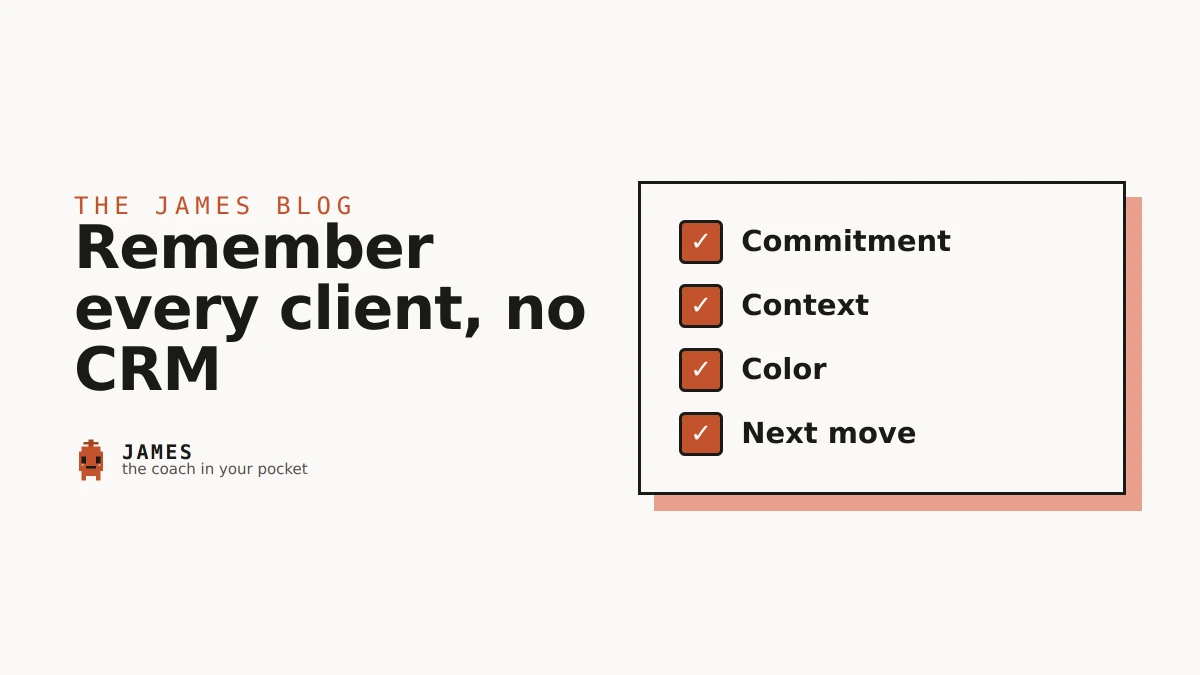
Keep one file per person, not a database of deals. After every call, write down four things in under two minutes: the commitment, the context, one piece of color, and the next move. Reread that file for two minutes before you talk to them again. That's the whole system, and it works because it matches how memory actually fails: fast, and specific to what you don't revisit.
This is for anyone with a smaller number of ongoing relationships, not a big funnel of one-time leads. Think coaches, consultants, advisors, agents, solo sellers. The advice below comes from testing a simple version of this system, and from building James, an app that does the same job automatically from your real calls.
Why a CRM doesn't fix this
A CRM is built to answer "where is this deal, and who owns it." That's a real job. CRMs do it well for teams pushing dozens of leads through set stages.
It's the wrong shape for a different job: "what did this person tell me, and what should I remember before we talk again." Search "how to keep track of clients" or "client notes template" and nearly every result is a CRM pitch. Sales blogs give you cold-call prep sheets for a stranger you're meeting for the first time. None of it covers a repeat relationship: the third call, or the tenth.
The fix isn't more software. It's a smaller, sharper habit: one file per person, four fields, written fast.
What's actually happening to your memory after a call
Here's why "I'll remember the important stuff" doesn't hold up. The most-cited data on how fast new information decays comes from Hermann Ebbinghaus's 1880s self-experiments. He memorized nonsense syllables, then tested how much he could still recall at set intervals:
| Time since learning | Share forgotten (Ebbinghaus, 1880) |
|---|---|
| 20 minutes | 41.8% |
| 1 hour | 55.8% |
| 1 day | 66.3% |
As of July 2026. Source: Ebbinghaus's original data, as tabulated in Murre & Dros, "Replication and Analysis of Ebbinghaus' Forgetting Curve," PLoS ONE, 2015.
Is 140-year-old data still good? Researchers Jaap Murre and Joeri Dros ran the same test on a new subject and published the result in 2015: "the results are similar to Ebbinghaus' original data." The shape holds up.
One caveat, stated plainly. Both studies measured memorized nonsense syllables, not real conversations. A real conversation has emotional weight. It repeats itself. So you'll likely keep more of a client call than the table above shows. But the pattern that's held up for over a century stays true either way: forgetting is front-loaded. Most of what you'll lose, you lose in the first day. Whatever you're going to write down, write it down before that window closes.
The four-field file
Here's the method. One note per person. Four fields, filled in after every call:
| Field | What goes in it | Example |
|---|---|---|
| Commitment | What you promised to do, and what they promised to do | "I'm sending the revised proposal by Friday. She's checking with her partner before deciding." |
| Context | Why the conversation went the way it did | "Hesitant on price because a competitor quoted lower last month — she brought it up twice." |
| Color | One specific, non-business detail they mentioned | "Daughter starts college in the fall, she mentioned it twice unprompted." |
| Next move | The single next action, with a date if there is one | "Follow up Friday with the proposal. Ask how the college move-in went." |
Four fields, not forty. The point isn't a complete transcript. It's the smallest set of facts that makes you sound like you were paying attention. You were.
Color earns its place for a specific reason. It has nothing to do with the deal. It has everything to do with the relationship. Bring up their daughter's college move, unprompted, three weeks later. That's the difference between "a vendor who took notes" and "someone who was actually listening." No CRM template we found even has a field for it. It's usually the first thing forgotten. It's also the thing people remember you for, when you don't forget it. (Here's how to actually bring it up without sounding rehearsed.)
The two-minute window that makes it work
Timing matters more than the format. Write the four fields within 5 minutes of hanging up, not that evening. Look at the table again: by the one-hour mark, you've already lost more than half of it. A fast voice memo in the car beats a careful write-up later, done from a foggy memory.
The other half is just as easy to skip. Reread the file for two minutes before your next call with that person. Writing it down without rereading it is just journaling. The payoff: you walk into call three already knowing what call two ended on.
What about remembering names?
"How to remember names" gets real search volume on its own. It's a separate question, but it deserves a straight answer here. Skip the memory-palace tricks and the rhyming pegs. They work in isolation. They rarely survive a real conversation, where you're also listening and thinking about what to say next.
Here's the version that holds up: attach the name to a fact from your four-field note, not to a rhyme or an image. "Maria, hesitant on price, daughter starting college" recalls better than "Maria rhymes with area." It's tied to something you actually care about remembering. The file you're already keeping does double duty as a name-recall tool. You don't need a second system.
If you record your calls to help with this
Some people record client calls to make this easier, then listen back for details they missed live. That's a reasonable approach. It raises a separate question: does the other person need to know? In most US states, yes (general information, not legal advice — laws vary by state). We wrote a full state-by-state guide with word-for-word scripts for asking if this is part of your system. Recording isn't required for the four-field method. Plenty of people run it entirely from memory and a fast note.
What to do with this
- Pick one place for your notes. A note app, a plain doc, a page per person. The tool matters less than doing it every time.
- After every client call, fill in the four fields within 5 minutes: commitment, context, color, next move. Time-box it to two minutes. If the next move is a follow-up email, here's the structure and 12 templates by outcome.
- Before your next call with that person, reread their file for two minutes. This is the step people skip, and it's the one that actually pays off.
- If you record calls to help capture detail, ask first. See the consent scripts by scenario.
- Don't add fields. The system holds because it's fast. A CRM's twelve-field contact record is why you stopped using it.
Sources
- Murre, J.M.J. & Dros, J., "Replication and Analysis of Ebbinghaus' Forgetting Curve," PLoS ONE, 10(7), e0120644, 2015 — doi.org/10.1371/journal.pone.0120644
Published July 16, 2026. Last verified July 31, 2026. This article is part of our research library. We publish what we learn building James, whether or not it sells an app.
Frequently asked questions
How do I keep track of clients without a CRM?
Keep one file per person (a note, a doc, a page — the tool doesn't matter) and write four things after every call: what you committed to, the context behind the conversation, one specific detail they mentioned, and the next move. Read that file for two minutes before your next call with them. A CRM tracks pipeline stages across many strangers; this tracks what one person actually told you.
What should I write down after a client call?
Four things, in under two minutes: what you promised to do and what they promised to do (the commitment), why the conversation happened the way it did (the context), one non-business detail they mentioned (the color), and the single next action (the next move). Do it within 5 minutes of hanging up, before the details fade.
How can I remember client conversations for months?
Write the four-field note right after the call, then reread it for two minutes right before your next call with that person. The writing and the rereading are both required. Classic memory research (and a 2015 replication) shows you lose most new information within a day; a file only helps if you actually reopen it before it matters.
Is a CRM overkill for a solo relationship-based business?
Not overkill, wrong tool. CRMs are built to manage a pipeline of many leads moving through stages. If your job is a smaller number of ongoing relationships you talk to repeatedly rather than a large one-time-lead funnel, a CRM adds fields and stages you don't need. A simple per-person file does the actual job: helping you remember what one specific person told you.