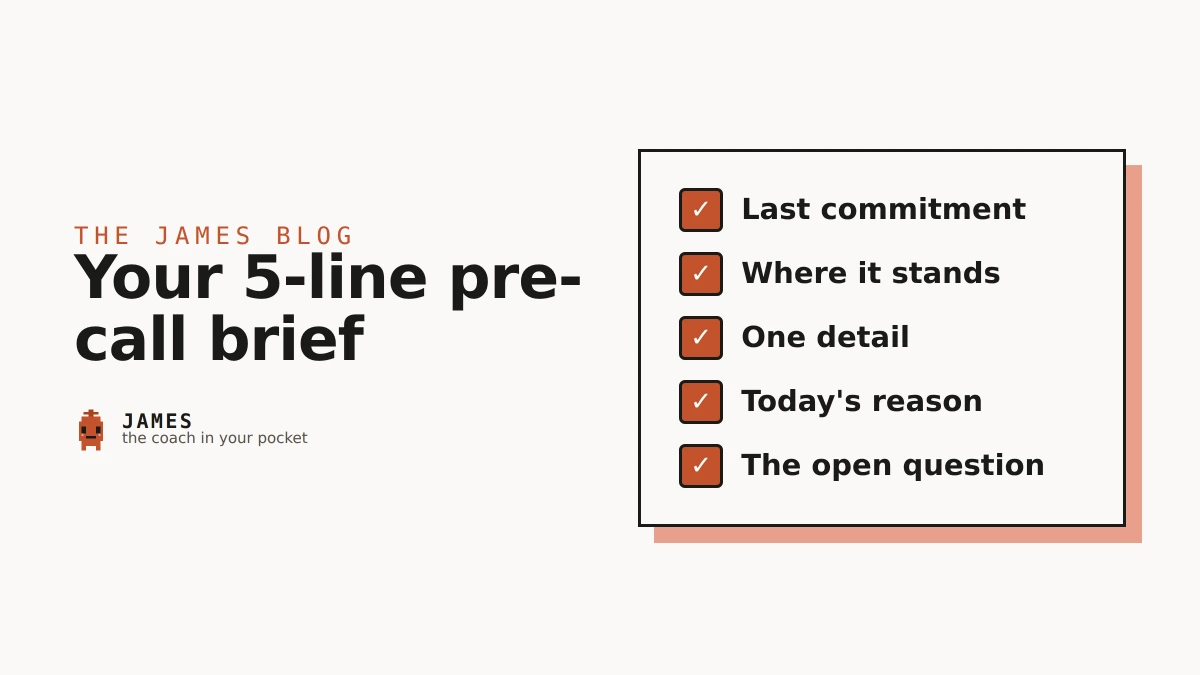
Before you call someone you already know, spend 2 minutes reading five things. The last commitment, where it stands, one personal detail, today's reason for calling, and the open question you still need answered. That's the whole brief. Read your own notes on purpose, right before the call.
This is for anyone who talks to the same people repeatedly: coaches, agents, advisors, account managers, solo sellers. The method comes from testing it against the pre-call planning advice already out there. It also comes from a fresh read of what CRM users say about the apps built to hold this exact information.
Why the pre-call planning advice online doesn't fit a repeat client
Search "pre-call planning" or "meeting prep checklist" and every result assumes the same thing: you're about to meet a stranger. Research their company website. Check their LinkedIn. Scan the industry news. Gather intel before you introduce yourself.
That's a real job, for a first call. It's the wrong job for a fifth call. You don't need to research someone you already talked to three times. You need to remember what happened the last time you talked.
One exception is worth naming. Financial-advisory firms run something closer to a real repeat-client prep process. It pulls account history, prior notes, and follow-up items before a scheduled meeting. But that version assumes a team. It assumes staff to do the pulling and up to a week of lead time for one meeting. If you're a solo operator, you don't have a paraplanner. You have the ten minutes between your last call and this one.
That gap in the middle is what the brief below fills: fast, built from your own notes, made for one person.
What we found when we read 300 reviews of the apps built for this
If continuity is the actual problem, someone should have built the tool for it already. Several have. Cloze, Contacts Journal, and Follow Up Boss are personal-CRM apps built specifically to hold a running history per contact. We read the 100 most recent App Store reviews of each, 300 total. We tracked two things: reviews that praise having contact history in one place, and reviews that describe actually rereading it before the next call.
Seventeen of the 300 reviews praise exactly that storage. Users like seeing a contact's emails, calls, and notes together instead of hunting across separate apps. One review from a Contacts Journal user gets at the other half directly:
"The auto-logging texts and calls initiated from within the app has helped me a bunch of times when I had to ask myself “when did we talk about this thing? What did we agree on?”" Contacts Journal, 4★, "Awesome, but missing bday filtering and reminders," May 2026
That's one review, out of 300, that describes the consult step. It's the habit of opening the history back up before it matters, not just after the fact. The other 16 storage-praise reviews only describe capturing information well. None of them describe rereading a contact's file right before calling. Neither do the other 283 reviews we read.
The tools aren't the problem. The habit is missing, whether or not you use one.
The 5-line brief
Build this from whatever notes you already keep on the person, even a plain note app. If you use the four-field method from our client-memory piece, you already have most of this: commitment, context, color, next move. The brief is that same file, read forward instead of written backward. It adds one line the file doesn't have: what you still need to find out.
| Line | What it captures | Example |
|---|---|---|
| Last commitment | What you both promised last time, and whether it happened | "I said I'd send the revised proposal by Friday. She said she'd check with her partner." |
| Where it stands | Did the commitment actually happen, on either side | "Proposal sent Thursday. No word back on the partner conversation yet." |
| One detail | A non-business fact worth bringing up | "Daughter starts college this fall." |
| Today's reason | Why you're calling now, specifically | "Following up on the proposal before her decision deadline Friday." |
| The open question | What you still don't know, and need to ask | "Has she talked to her partner yet, or is that still pending?" |
Five lines, not a summary of the whole relationship. The point is what you need in the next 60 seconds of the call, not everything you've ever learned about the person.
As of August 2026.
When to actually read it
Timing matters as much as the content. Build the brief in the transition window right before the call. Don't do it first thing in the morning for a call that's hours away. The reason is simple: whatever you load into working memory fades fast. A brief you read at 9am for a 2pm call has already gone soft by the time you need it. Read it, then dial. Don't let anything sit between the two.
What the brief covers, by call type
The five lines don't always carry equal weight. What matters most shifts depending on where you are with that person.
| Call type | What to weight in the brief |
|---|---|
| Second call, soon after the first | Lean on "today's reason" and "the open question." You're still filling in basics, not managing a relationship yet. |
| After a gap of weeks or months | Lead with "where it stands." Confirm nothing changed before you reference something stale. |
| Right after a call that went badly | Be honest in "last commitment" about what you owe them, not just what they owe you. |
| Renewal or ongoing-relationship call | "One detail" carries more weight here. This is where the relationship gets reinforced, not just the transaction. |
What to do with this
- Keep a per-person note. If you don't have one, start with the four-field method: commitment, context, color, next move. Write it within 5 minutes of hanging up.
- Before your next call with that person, pull the five lines above from that note. Two minutes, not longer.
- Do it in the transition window, right before you dial. Not that morning, not the night before.
- If the reason for calling changed since your last note, say so in "today's reason." Don't force a brief written for a different purpose to cover a new one.
- End on the open question. It's the one line that turns a summary into something you can actually use on the call.
- After the call, update the note before you brief yourself again. If the call ends in a next step you owe them, use these follow-up templates instead of writing one from scratch.
Sources
- Kitces.com, "Client Meeting Prep Checklist For Financial Advisors" — kitces.com/blog/client-meeting-prep-checklist-for-financial-advisors
- Our data: the 100 most recent App Store reviews of Cloze, Contacts Journal, and Follow Up Boss. 300 total, pulled July 2026 and read in full this session.
Published August 1, 2026. Last verified August 1, 2026. This article is part of our research library. We publish what we learn building James, whether or not it sells an app.
Frequently asked questions
What should I do before a call with a client I already know?
Spend 2 minutes reading 5 things from your notes on that person: the last thing you both committed to and whether it happened, one non-business detail they mentioned, why you're calling today specifically, and the one question you still need answered. Do this right before the call, not hours ahead of it.
How is pre-call planning different for a repeat client versus a new prospect?
Pre-call planning for a stranger means researching their company, role, and industry from public sources. A repeat client doesn't need research, they need continuity. The prep is reading your own notes from the last conversation, not gathering new outside information.
What's the difference between a client file and a pre-call brief?
The file is what you write after a call: a running per-person record. The brief is what you read before the next one: a shorter, forward-looking pull from that same file, built to be scanned in under 2 minutes, ending in a specific question you still need answered.
Do CRM apps already do this automatically?
They store the history well. Reading it back before you need it is a separate habit most CRMs don't build in and most users don't describe doing, based on what people actually write in reviews of these apps. The software solves storage. The brief is still something you have to do yourself.