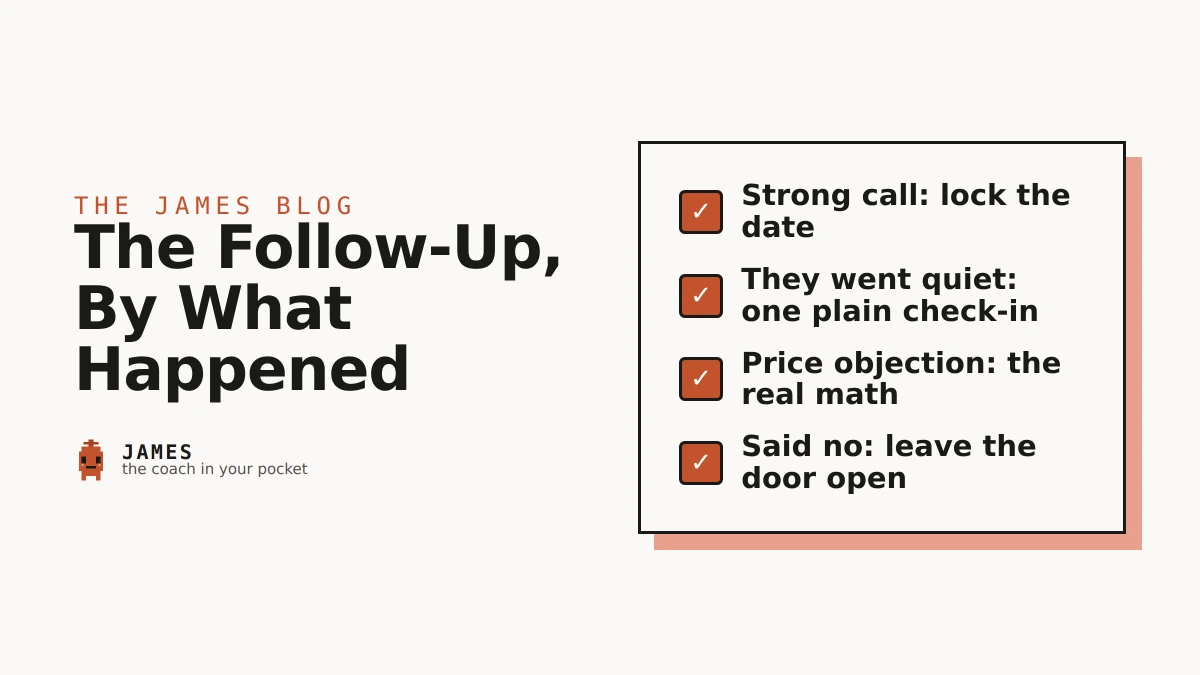
Send your follow-up email the same business day, ideally within two hours of hanging up. Keep it under 150 words: what you heard, what happens next, and one specific thing they said, in their words. The templates below are sorted by what actually happened on the call. "Let me think about it" and "send me a proposal" need different emails, not the same one with the name swapped.
This is written for anyone who has a real sales conversation, then has to turn it into a follow-up email. Sellers, consultants, agents, coaches closing their own work. It draws on the real research behind the timing advice you'll see everywhere. Most of it gets misquoted, see below. It also covers the plain mechanics of writing a fast, specific email instead of a generic one. If you want to catch what's driving the outcome before the email stage, we've also written a self-review system for scoring your own sales calls.
Does the "follow up within an hour, 700% more likely" stat actually apply here?
No, and this is worth untangling because it's repeated on nearly every page about this topic. The real study is Harvard Business Review, March 2011, by James B. Oldroyd, Kristina McElheran, and David Elkington. We read the original PDF directly. Here's what it actually measured: the researchers audited 2,241 U.S. companies to see how fast each one responded to a brand-new web lead: someone who had just submitted a form and never spoken to the company before. Only 37% responded within an hour. In a separate dataset of 1.25 million leads, companies that made contact within an hour of that first inquiry were "nearly seven times as likely to qualify the lead... as those that tried to contact the customer even an hour later."
Seven times isn't "700% more likely" (that would be eight times). More to the point: this is speed-to-first-contact on a cold lead who's never heard your voice. It says nothing about how fast to email someone you just spent 30 minutes talking to. The two situations aren't the same. A cold lead goes cold because they forget they filled out a form. A prospect you just had a real conversation with already knows who you are. The risk isn't that they forget you exist. It's that the specific details of what you agreed to start fading.
That's the actual reason speed matters here, and it's a different reason than the misquoted stat implies.
So how fast, really?
Same business day. HubSpot's sales team frames it as keeping "the conversation at the top of your prospect's mind" while it's still fresh. Grammarly's guide is more specific: "send your first sales follow-up email within two hours of the call, or no later than the end of the same business day." Both are practitioner guidance, not a controlled study. But they point at the same logic: you're racing your prospect's memory, not a conversion algorithm.
| Situation | When to send |
|---|---|
| Call ended before 4pm their time | Within 2 hours |
| Call ended after 4pm their time | First thing next business day, not that night |
| Group or committee call | Same day, CC everyone who was in the room |
| They went quiet with no next step agreed | 2–3 days later, one plain check-in |
| They said "let me think about it" | Same day recap, then whatever date they gave you for a decision |
As of July 2026. Timing guidance from HubSpot and Grammarly Business sales content; see Sources.
The structure that actually gets read
Three parts, under 150 words:
- What you heard. Two or three things, not a transcript. The point isn't proving you were in the room; it's proving you were listening.
- What happens next, with a date. "I'll follow up soon" isn't a next step. "I'll send the proposal by Thursday, can we look at it together Friday at 2?" is.
- One specific thing they said, back in their own words. This is the part almost every template skips, and it's the difference between a follow-up and a form letter.
The reference-back trick
Here's the single sentence that does the most work in any follow-up email: something the person actually said, close to how they said it. Not a paraphrase of the whole call, one sharp detail.
Generic: "Thanks for the call today. I understand you're looking for a solution that fits your budget and timeline."
Referenced: "You mentioned you got burned by a six-month rollout at your last company, and that's the thing you're most worried about repeating. That's exactly what we scoped week one around."
The second version isn't longer or more polished. It's just specific to a thing only this person, on this call, said. You can't template that part in advance, which is exactly why it works. If you're also trying to hold onto details like this across a longer relationship, not just for one follow-up email, we wrote about a simple system for that.
12 templates, by what actually happened
Two registers show up below on purpose. Some calls call for warm and reassuring; some call for direct and a little blunt. Match the register to the relationship, not to a script.
- Strong discovery call, clear next step. "Good talking today. You're dealing with [specific problem they named]. Here's what I'm sending by [date], and let's look at it together on [date/time]."
- Demo where one feature landed. "You lit up when I showed [specific feature]. That's the piece that solves [problem they mentioned]. Here's a two-minute clip of just that part, in case you want to show your team without replaying the whole demo."
- They went quiet, no next step set. "Wanted to close the loop on our call. You mentioned [specific detail]. Worth 15 minutes to figure out if this is a fit, or is the timing just wrong right now? Either answer is fine, I just don't want to keep guessing."
- "Let me think about it." "Take the time you need. One thing worth having in writing while it's fresh: you said the real blocker was [specific concern], not price. If that's still true when you're deciding, here's the one page that speaks to it directly."
- Price objection came up. "You're right that [price] is a real number, not a small one. Here's the actual math on [specific value point they cared about] so it's not just my word against your budget."
- They said no. "Appreciate you being straight with me. If [the reason they gave] changes down the line, I'm easy to find. No follow-ups planned unless you reach out first."
- Group or committee call. "Great group discussion today, [names]. Recapping so everyone's working from the same page: [3 bullets, one per major point raised]. [Name], you asked about [specific question]. Answer's below."
- They mentioned a referral in passing. "You mentioned [colleague's name] might run into the same problem. No pressure at all, but if it comes up, happy to do the same call with them. Meanwhile, here's what we agreed to next on your side: [next step, date]."
- "Just send me some info." "Here's exactly what you asked for, not a full deck: [1-2 relevant items]. You mentioned [specific context], so I picked these because they speak to that directly. Not because they're everything we've got."
- No next step was set on the call. "Realized we didn't lock in a next step before we hung up. My fault. Would [specific date/time] work for a short follow-up, or would you rather I just send [specific thing] and you get back to me?"
- Long-standing client, warm relationship. "Good to catch up, as always. Sounds like [specific personal or business detail they mentioned] is the main thing on your plate right now. I'll have [agreed deliverable] to you by [date]. Talk soon."
- They no-showed or you had to reschedule. "No worries on missing today, these things happen. I held [specific time] open again for [proposed new date]. Let me know if that works, or send a time that's better for you."
What to do with this
- Write the recap within two hours of hanging up, or first thing the next business day. Not because of a misquoted statistic, because your memory of the call is at its best right now.
- Pick the template above that matches what actually happened, not the closest generic one. A "let me think about it" email and a "strong next step" email should not read the same.
- Add one specific, verbatim detail from the call before you hit send. If the email would make sense sent to any prospect from any call, it's not done yet.
- Put a real date in the next step, not "soon" or "circling back."
- Stop at the cadence you agreed to on the call. If you didn't agree to one, one plain check-in a few days later is enough before you let it go.
Sources
- Oldroyd, J.B., McElheran, K., & Elkington, D., "The Short Life of Online Sales Leads," Harvard Business Review, March 2011 — hbr.org/2011/03/the-short-life-of-online-sales-leads
- HubSpot, "5 Recap Email Templates to Use After Connect, Discovery, and Demo Calls" — blog.hubspot.com/sales/recap-email-templates
- Grammarly Business, "How to Write a Follow-Up Email After a Sales Call, With Templates" — grammarly.com/blog/emailing/sales-follow-up-email
Published July 17, 2026. Last verified July 17, 2026. This article is part of our research library. We publish what we learn building James, whether or not it sells an app.
Frequently asked questions
How soon should I send a follow-up email after a sales call?
Same business day, ideally within two hours of hanging up. If the call ends after 4pm their time, first thing the next morning beats a late-night email. The reason isn't a magic conversion-rate number — it's that you both still remember what was actually said.
What should a follow-up email after a sales call include?
Three things, in this order: a one-line recap of what you heard (not everything, the two or three things that mattered), the agreed next step with a date attached, and one specific detail from the conversation that shows you were listening. Keep the whole thing under 150 words.
Is the 'follow up within an hour, 700% more likely' statistic real?
The underlying study is real (Harvard Business Review, 2011, Oldroyd/McElheran/Elkington), but it measured how fast companies responded to a brand-new web lead who had never talked to them before, not a follow-up email after a call that already happened. Firms that contacted a fresh lead within an hour were about seven times as likely to have a meaningful conversation. That number gets rounded up and reused for a completely different situation.
How many follow-up emails should I send after one sales call?
One recap right after the call, then follow the cadence you already agreed to on the call itself (a specific date, not 'circling back soon'). If they went quiet with no agreed next step, one plain check-in two to three days later is reasonable. Past that, you're guessing at their calendar instead of using theirs.