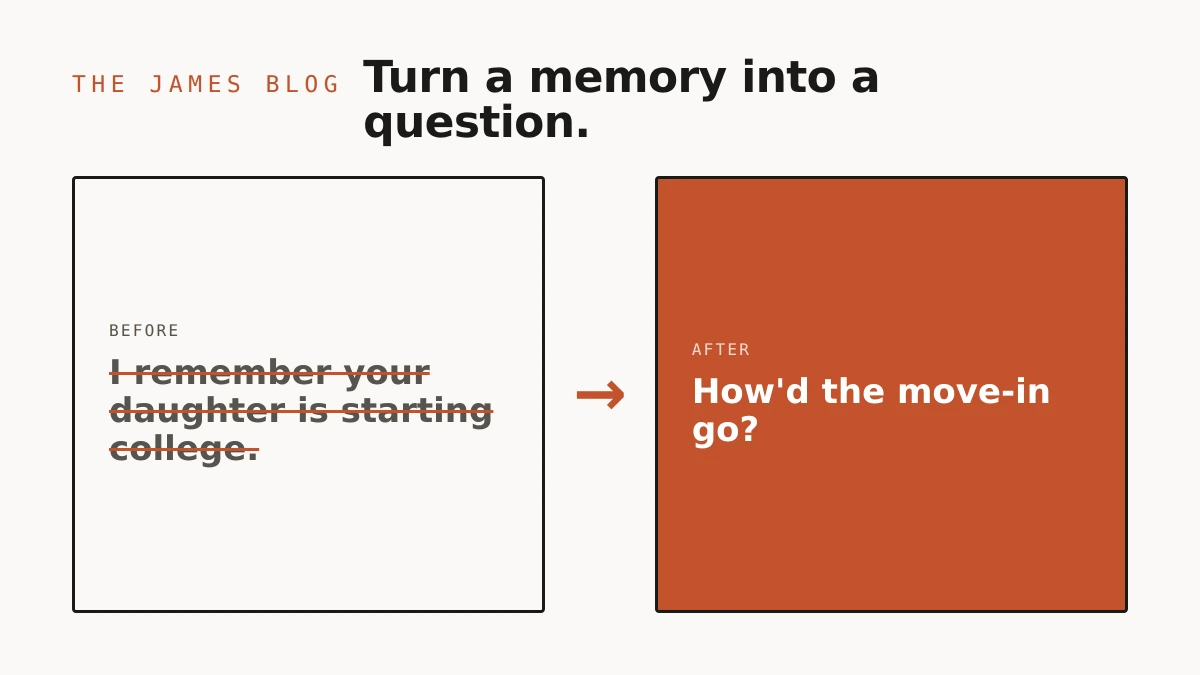
Bring up one specific, non-business detail from your last conversation, framed as a real question about how it turned out. Not more small talk. Not a list of everything you remember. One detail, asked about, then dropped. That's the whole technique, and it works precisely because it's the one thing a stranger-rapport script can't fake.
This is for the second call and every one after it, not the first meeting. For a first conversation, the standard advice (find common ground, mirror their tone, listen more than you talk) is genuinely good and doesn't need reinventing here. This piece is about what to do differently once you're past that.
Why the standard rapport advice doesn't fit here
Search "how to build rapport" and the same handful of techniques show up everywhere: mirror the other person's body language and tone, find common ground, ask about their weekend, listen more than you talk. We checked the current top-ranking guides directly, and none of them treat a fifth call differently from a first one. Yesware's rapport guide, for one example, tells readers to "make slight adjustments to match the prospect's behavior." That's a general technique, applied the same way no matter how long you've known the person.
That's not bad advice. It solves a specific problem: two people with zero shared history, trying to find a reason to trust each other fast. It stops being the right advice once you have shared history. Mirroring someone's tone works when you have nothing else to go on. Once you've talked to them three times, you have something better: an actual thread from the last conversation. Use it. It beats performing a general rapport technique on someone who already knows you.
How much of that search volume is actually about sales
Before leaning on the numbers, here's what they do and don't show. "Building rapport" and "rapport building" each get 9,900 searches a month in the US. Neither term has any recorded ad bid data. That's a large, apparently uncontested informational term. But it's a general term. Rapport comes up in interviews, therapy, teaching, and negotiation, not just sales calls, and the data doesn't let us claim otherwise. The sales-specific phrasings of the same idea are far smaller. "Building rapport in sales" gets 50 searches a month. "How to build rapport on a sales call" gets 10. That gap is real. It's most of the reason nobody bids on the broad term: it's too general to target with a sales pitch.
None of that changes the finding above. Whatever share of that 9,900 is sales-related, the pages that rank for it still don't split first-time rapport from repeat rapport. The search term is broad. The advice on it is narrow in a different way. The gap this piece fills doesn't depend on which slice of the volume is ours.
The technique: one callback, framed as a question
Here's the version that works once you already know someone. Pull one specific, non-business detail from your notes on your last conversation with them. Bring it up once, early, framed as a genuine question about what happened next, not a fact you're reciting to prove you remembered.
The difference is in the framing, not the detail itself:
| Framing | Example | Why it lands differently |
|---|---|---|
| Recited fact | "I remember you said your daughter was starting college." | Proves you took a note. Doesn't invite a response. |
| Genuine follow-up | "How'd the move-in go, with your daughter starting college?" | Asks for an update. Turns the detail into a real exchange. |
The second version works because it does something a stranger-rapport technique can't. It shows the relationship has a history. It hands the other person something easy and real to answer. A stranger has nothing to follow up on yet. You do.
Where the detail comes from is a separate, already-solved problem: write down one piece of color after every call, in whatever note system you already use. We've written the full four-field version of that habit here if you don't have one yet. This piece is about the moment you actually use what you wrote down, not about capturing it.
What not to do with it
Two ways this backfires, both easy to avoid:
Don't turn it into an update request. Asking about one detail is a follow-up. Asking about three things they mentioned in passing (their kid's college move, their vacation, a work deadline) in the same call stops sounding like attention and starts sounding like you're checking a list. Pick the one that's most current and let the rest go.
Don't reuse the same detail past its shelf life. A callback works once, maybe twice. Bring up the same college-move detail a fourth call in a row, months after it stopped being new, and it stops reading as memory and starts reading as a script you never updated. If nothing's changed since your last note on someone, the honest move is to skip the personal line for that call, not force one.
What reviewers of plain contact-tracking apps say about this, unprompted
We went looking for evidence people already value this, in a place where it wouldn't be flattered into existing: the App Store reviews of personal contact-management apps, none of which are sold as sales or rapport tools. We read the 100 most recent reviews each of Cloze, Contacts Journal, and Follow Up Boss (300 reviews total) for people crediting a relationship-memory feature, like a birthday or anniversary reminder, with helping a real relationship, not just organizing contacts. The three apps get reviewed at very different rates, so "100 most recent" covers very different spans: Cloze's 100 stretch back to 2018, Contacts Journal's cover roughly the last year, Follow Up Boss's cover roughly the last five and a half years.
Two reviews said so explicitly:
"The features I love the most are the email open tracking, scheduled emails, custom fields with anniversary reminders, email templates, and last but not least the files sections" Cloze, 5-star review, June 2019
"I use it for my business. It's easy to add names and track all communications with them. I set up reminders to follow up with them and to contact them on their birthdays." Contacts Journal, 5-star review, May 2026
Two reviews out of 300 is a small number, and we're not going to pretend otherwise. The count isn't the point. A blunt, generic feature (a birthday reminder, not anything built for rapport specifically) is what people reach for when nothing purpose-built exists. It still gets named as a favorite feature, unprompted, years apart. The job is real enough that people build a rough version of it out of whatever's available.
What to do with this
- Keep one note per person with at least one non-business detail on it. If you don't already have a system, start with the four-field version: commitment, context, color, next move.
- Before your next call, pick the single most current detail from that note. Not the most memorable one. The most recent.
- Bring it up once, early, as a question about what happened next. Not a statement proving you remembered.
- If nothing's changed since your last note, skip the personal line. A stale callback costs you more than silence does.
- After the call, if there's a next step, put it in writing. Here's a follow-up email structure with templates by outcome if that's the next move.
Sources
- Yesware, "Building Rapport: 10 Best Ways to Instantly Build Trust in Sales," 2026 — yesware.com/blog/building-rapport
- Our data: US search-volume and competition data for "building rapport" and related terms, pulled July 2026. Our data: 300 most-recent App Store reviews of three personal contact-management apps (Cloze, Contacts Journal, Follow Up Boss), read for relationship-memory feature mentions in July 2026.
Published July 31, 2026. Last verified July 31, 2026. This article is part of our research library. We publish what we learn building James, whether or not it sells an app.
Frequently asked questions
What's the difference between rapport building and small talk?
Small talk fills time with low-stakes, generic topics — weather, weekend plans — because there's nothing specific to talk about yet. Rapport building with someone you already know skips that step: you reference something real from your last conversation instead of manufacturing a new topic from scratch.
How do you build rapport with a client you already have?
Bring up one specific, non-business detail they mentioned last time, framed as a question about how it turned out. 'How did the move go?' works because it's specific and shows you were listening. A generic 'how's it going?' doesn't, because it would work on anyone.
Is it weird to bring up something personal a client mentioned before?
Only if you overdo it. One detail, asked about naturally, reads as attention. Interrogating them for updates on three things they mentioned in passing, or repeating the same detail every single call, reads as either surveillance or a script. Use it once, then let it go.
How often should I bring up something personal with a client?
Once per call at most, and only if you actually have something new. If nothing's changed since your last note, skip the personal line rather than recycle an old one. A stale callback is worse than none at all.