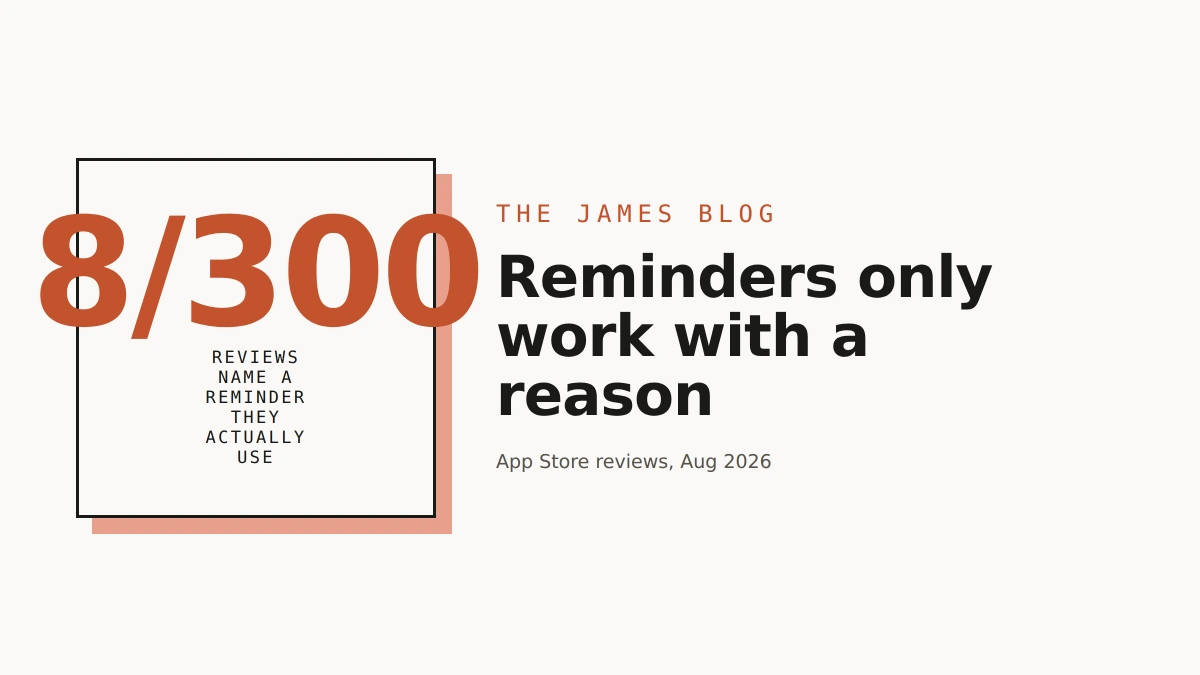
Don't schedule a follow-up. Schedule a reason. Of 300 App Store reviews we read across three client-relationship apps, only 8 people name a reminder feature at all. The ones who describe what it's for tie it to something specific: a promise they made, a birthday on file. Nobody praises a blank "check in with this person" ping. The standard advice here (quarterly newsletters, twice-a-year calls) is a broadcast schedule built for a big list of near-strangers. It isn't built for a person you actually know.
This is for anyone with real, ongoing contact with the same people. Consultants, coaches, agents, advisors, freelancers who close their own work. Not a one-time email after a single call (we've written that one separately). Not chasing someone who's gone quiet, either. This is the slower question: when do you reach out to someone you already know, and what do you actually say when you do.
What does the standard advice actually say, and is it backed by anything?
We fetched the two most-cited real-estate guides for this question directly. We didn't trust a summary. Top Producer's cadence: "every quarter: send a market update... twice a year: check in with a quick call, text or email." Market Leader's system: closing gifts, social engagement, postcards, client-appreciation events, non-salesy email content. Neither page cites a study, a data source, or even an internal result behind these numbers. They're stated as practice, not measured.
That doesn't make them wrong. A quarterly market update is a fine, low-effort way to stay visible to 200 past clients you can't call one by one. It's a mass cadence, built for staying top-of-mind with a list. That's not what "following up with a client" means to someone who actually knows the person on the other end.
Why doesn't the "how many touches" research apply here?
Search for follow-up cadence and you'll mostly find sales-prospecting advice. Touch counts in the 5-to-12 range, quoted everywhere, with no consistent original source behind the number. That advice answers a different question. It's about persistence before a relationship exists. Wearing someone down from silence to a first yes. A client follow-up starts from the other side of that line. You already have the relationship. The job isn't persistence. It's remembering something true about this person and using it before it goes stale.
Confusing the two produces exactly what shows up in real-estate follow-up guides aimed at past clients. Touch counts and send-cadences, borrowed straight from prospecting, applied to people who already hired you.
What does the review data say actually works?
We read the 300 reviews on file for three apps built around ongoing client contact: 100 each for Cloze, Contacts Journal, and Follow Up Boss. Eight reviews name a reminder feature at all. Most say what it's for.
The pattern in what people actually praise, when they say more than "I use reminders":
"...reminds me when I've made a commitment in an email that I need to put in my calendar..." Njerps, Cloze review, 2018
"The feature 'remind me to contact this person if they do not respond to my email'..." PetRun, Cloze review, 2019
"I set up reminders to follow up with them and to contact them on their birthdays." ImagineDat, Contacts Journal review, May 2026
Every one of those is a reminder attached to a fact: a promise made, silence after an email, a birthday on the record. One review in the whole sample complains about this feature. It isn't complaining that reminders don't work. It's complaining about the setup:
"...no view or reminder for birthdays... in order to be reminded about birthdays, I have to manually create a To Dos for each birthday." ZachRivers, Contacts Journal review, May 2026
Read those four together and the shape of the problem is clear. The reminder isn't the hard part. Getting the fact into the system before you lose it is the hard part. A blank "follow up with client" ping on a calendar carries no information. By the time it fires, you're trying to remember what was even worth mentioning.
| What the 8 reminder mentions describe | Count (of 300 reviews) | What it's attached to |
|---|---|---|
| A reminder tied to a specific commitment or trigger | 2 (both quoted above) | A promise made, or silence after one |
| A reminder tied to a birthday/anniversary | 3 (2 praise, 1 complaint about setup friction) | A date already on file |
| A reminder mentioned with no stated reason | 3 | Unspecified |
| "I haven't let one lead fall between the cracks" (separate mention, not counted above) | 1 (Follow Up Boss) | Pipeline stage, not a personal fact |
Counts from a full read of the banked App Store reviews for Cloze, Contacts Journal, and Follow Up Boss, 100 each, 300 total, read in August 2026.
So what actually is the follow-up "system"?
Two parts, and the second one is where most systems quietly fail:
- Log the fact the moment you hear it. Not "follow up with Sarah in a month." "Sarah's lease renewal is in October and she mentioned wanting more space." The fact is the whole value. A date with no fact attached is just a calendar ping you'll dismiss.
- Let the reminder carry the fact, not just the date. When it fires, you should be reading the actual thing worth mentioning, not staring at a name trying to reconstruct why you wrote it down.
If you already have a habit of writing quick notes after client conversations, we've written about a simple system for that part. The follow-up reminder is just that same note, resurfaced on a timer. The fact you're logging doesn't have to be businesslike, either. The same logic applies to the small, personal details that make a reconnection feel real instead of scheduled. And if the follow-up is happening right after a specific call, not on a delay, the mechanics of that email are a separate, more immediate question with its own timing and templates.
What to do with this
- Stop scheduling blank check-ins. A reminder with no attached fact gets snoozed, then ignored.
- Write the fact down within the hour, not "later." The Cloze and Contacts Journal reviews above both describe capturing something real, close to when it happened. Not weeks later.
- Use dates you already have (birthdays, renewal dates, project milestones) as anchors. Attach a real note to each one. The date alone won't tell you anything when it fires.
- Keep the quarterly newsletter if it's genuinely useful to your list. Just don't confuse it with personal follow-up. They're different jobs, for different-sized groups of people.
- If a reminder fires and you can't remember why you set it, that's a system failure, not a memory failure. Fix the capture step, not your memory.
Sources
- Top Producer, "How Often Should Real Estate Agents Follow Up?" — topproducer.com/blog/how-often-should-real-estate-agents-follow-up
- Market Leader, "Real Estate Client Follow-Up: It's Not Just for Prospects" — marketleader.com/blog/real-estate-client-follow-up-its-not-just-for-prospects
- Our data: a full read of the 300 most-recent App Store reviews across three client-relationship apps (100 each: Cloze, Contacts Journal, Follow Up Boss), read August 2026.
Published August 19, 2026. Last verified August 19, 2026. This article is part of our research library. We publish what we learn building James, whether or not it sells an app.
Frequently asked questions
How often should I follow up with existing clients?
There's no universal number that holds up. The advice you'll find (quarterly emails, twice-a-year calls) is a broadcast schedule for staying top-of-mind with a big list. It isn't a rule for one solo operator's real relationships. A better question than 'how often' is 'do I have a real reason to reach out right now.' A fact worth mentioning beats a date on a calendar.
What's the difference between following up with a client and following up with a lead?
A lead follow-up is trying to get a first yes from a stranger, so most advice on it is about persistence: how many attempts before you give up. A client follow-up starts from an existing relationship, so the job isn't persistence, it's remembering something true about a person you already know and using it.
Do reminder apps and CRMs actually help with client follow-up?
The ones with a good reminder feature help. But the review data shows a split. The reminders people praise are attached to a specific fact, like a promise or a birthday, not a blank date. The one complaint on this exact feature in our sample was about the manual work of attaching that fact in the first place, not about the reminder itself.
Is a quarterly newsletter a good way to follow up with past clients?
It's a reasonable low-effort way to stay visible to a large list, and real estate guides recommend it for that reason. It isn't personal follow-up, though. Neither of the two leading guides for this advice cites a study behind the quarterly and twice-a-year numbers. They're stated as practice, not measured.