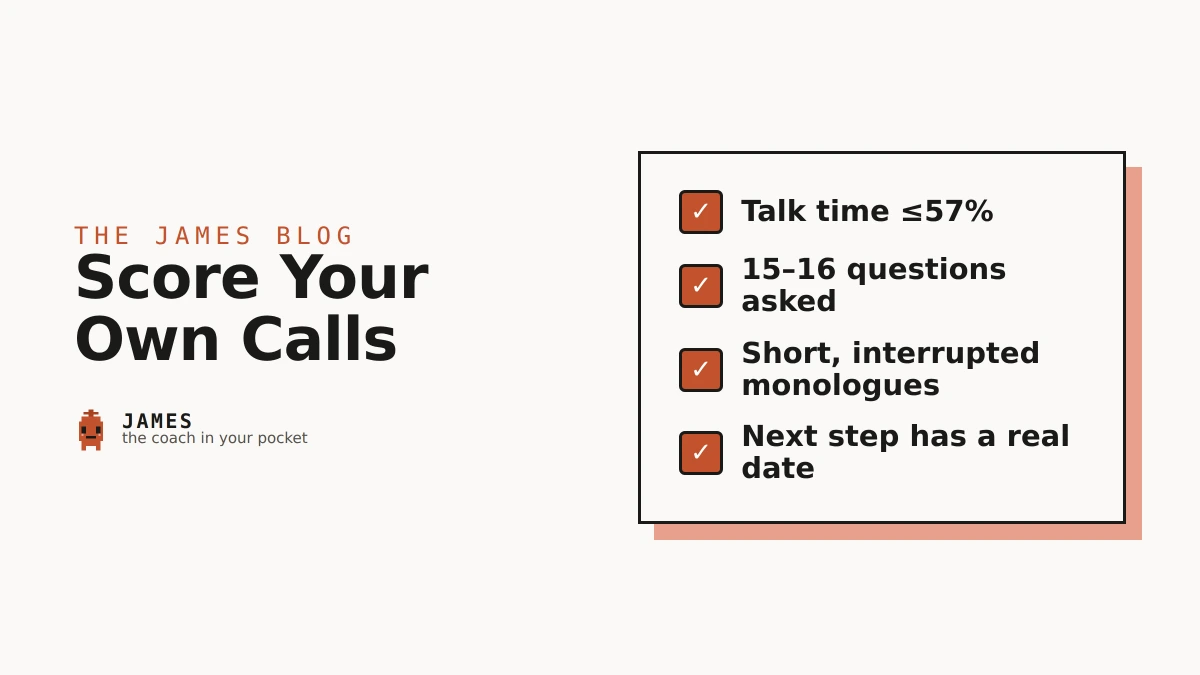
Score 4 things when you review your own call: how much you talked, how many real questions you asked, your longest unbroken stretch of talking, and whether the next step got a specific date. Gong's dataset of 326,000 sales calls shows these are exactly where won deals and lost deals separate. Reps on closed-won calls talked 57% of the time and asked 15–16 questions; reps who lost talked 62% and asked closer to 20. You don't need a manager or a team platform to check yourself against that.
This is written for anyone who has real sales conversations and no one grading them. Solo sellers, consultants, agents, coaches closing their own work. We built the scorecard below straight from Gong Labs' published research, checked against the live source, not a secondhand summary. Then we checked something else: do people actually want to review their own calls? We read our banked App Store review data for Siro and Rilla, two apps built around exactly that, to find out.
What should you actually score when you review your own call?
Four things, all backed by the same dataset, all things you can hear on a playback without any software.
| Signal | Target | What the data shows |
|---|---|---|
| Your talk time | 57% or less | Reps on won deals talked 57% of the call; reps on lost deals talked 62%. Overall average: 60% talking, 40% listening. |
| Questions asked | 15–16 | Won calls averaged 15–16 questions from the rep. Lost calls averaged about 20 — past a point, more questions reads as an interrogation, not a conversation. |
| Longest monologue | Short, and interrupted | Won calls "feature shorter seller monologues"; lost calls "often feature long seller monologues" (Gong doesn't publish an exact second count for this one — treat it as a directional check, not a hard number). |
| Next step | A real date | Not measured by Gong, but the same logic applies: "I'll follow up soon" isn't a next step. A date and a time is. |
As of July 2026. Talk-time and question data: Gong Labs, "Mastering the Talk-to-Listen Ratio in Sales Calls," updated March 20, 2025, 326,000 calls of 10+ minutes. See Sources.
Notice what's missing from that table: nothing about your pitch, your close, or your objection handling. That's on purpose. Those are harder to score consistently and easier to rationalize in your own favor. Talk time, question count, and monologue length are close to un-fakeable once you're listening back with a stopwatch running. Your speaking pace right after an objection is another one worth timing — Gong's data shows top performers barely change pace under pressure, while average performers speed up.
Do people actually want to review their own calls, or is this extra work nobody asks for?
Worth checking honestly before recommending a habit. We read through our banked review pulls for two field-sales coaching apps built around call playback: Siro (76 reviews, the app's full accessible review window) and Rilla (53 unique reviews across both sorts, most-recent and most-helpful, deduplicated), 129 unique reviews total. We searched for reviewers describing the act of reviewing their own past calls, unprompted by a manager.
Six did, explicitly:
"as a sales representative/leader to be able to listen to my own 'game film', have It transcribed to text..." Siro, 5★, "Siro is a GAME CHANGER," March 2023
"I love using Rilla. Not only just to review my own sales conversations, but I listen to the more senior reps' conversations to help me replicate what they're doing." Rilla, 5★, "Rilla is so fun," May 2026
"As a former athlete being able to watch my game film in sales is an invaluable tool." Rilla, 5★, "Best App On My Phone!!," December 2023
That's a small, keyword-searched count. The sample already skews toward people delighted enough to leave five stars, so treat it as a signal, not a survey. But the "game film" comparison shows up more than once, unprompted, from people with no coaching background beyond having played a sport. Athletes review tape without anyone forcing them to. The habit isn't unnatural. It's just missing a system when the sport is sales calls instead of football.
The 15-minute weekly ritual
- Pick 2 calls from the week. Not your best one and not your worst one — pick one that felt fine and one you're still thinking about. The "fine" ones hide the most habits.
- Play back at 1.5x–2x speed. You already know the content; you're listening for pattern, not plot.
- Score the 4 signals from the table above. A stopwatch app running in the background for talk time is enough; you don't need transcription software for a weekly gut-check.
- Write down one thing to change, tied to whichever signal was furthest off target. Not a list. One.
- Try the fix on your very next call, then check it again the following week.
That's the whole system. Keeping it to 15 minutes isn't laziness. One testable change, carried into the next call, beats a full transcript audit that produces ten observations and zero behavior change.
What if a call had no clear next step at all?
That's its own signal, and the fastest one to catch on playback. Did the call end with a date attached to something? Or did it end with "I'll follow up" and nothing pinned down? We've written before about why a real date beats "soon" in the follow-up itself. The same discipline applies while you're still on the call, not just in the email afterward. If you can't tell from the recording what happens next, neither could the prospect.
What to do with this
- Pick this week's 2 calls now, before this list gets buried under new ones.
- Score talk time and questions first. They're the two Gong actually measured with hard numbers, and the easiest to catch yourself on.
- Note your longest monologue and one moment you could have asked instead of told.
- Check whether the call ended with a date, not a "soon."
- Pick exactly one fix and carry it into your next call. If you're also trying to hold onto what the person actually said, not just how the call went structurally, a simple per-person system helps there too.
Sources
- Gong Labs, "Mastering the Talk-to-Listen Ratio in Sales Calls," originally published 2016 by Chris Orlob, updated March 20, 2025 by Dan Morgese — gong.io/blog/talk-to-listen-conversion-ratio
Published July 18, 2026. Last verified July 18, 2026. This article is part of our research library. We publish what we learn building James, whether or not it sells an app.
Frequently asked questions
How do I review my own sales calls without a manager?
Pick 2 calls from the week, play them back at 1.5x–2x speed, and score 4 things as you listen: your talk time (aim under 60%), your longest unbroken stretch of talking, how many real questions you asked, and whether the call ended with a specific date attached to the next step. Write down one thing to try differently on the next call, not a list of ten.
What's a good talk-to-listen ratio for a sales call?
Gong's dataset of 326,000 calls (updated March 2025) found reps on closed-won deals talked 57% of the time, versus 62% on lost deals. The overall average across all calls was 60% talking to 40% listening. Aim to be at or below the 57% mark, not at zero — some talking is the job.
How many questions should I ask on a sales call?
In the same Gong dataset, reps who won deals asked 15 to 16 questions per call. Reps who lost asked more, about 20. More questions isn't better past that point; it starts to read as an interrogation instead of a conversation.
How often should I review my own sales calls?
Once a week is enough to build the habit without it becoming a second job. Two calls, 15 minutes, one change carried into next week. A monthly binge-review of 20 calls at once produces observations, not behavior change, because there's no single next call to test the fix on.