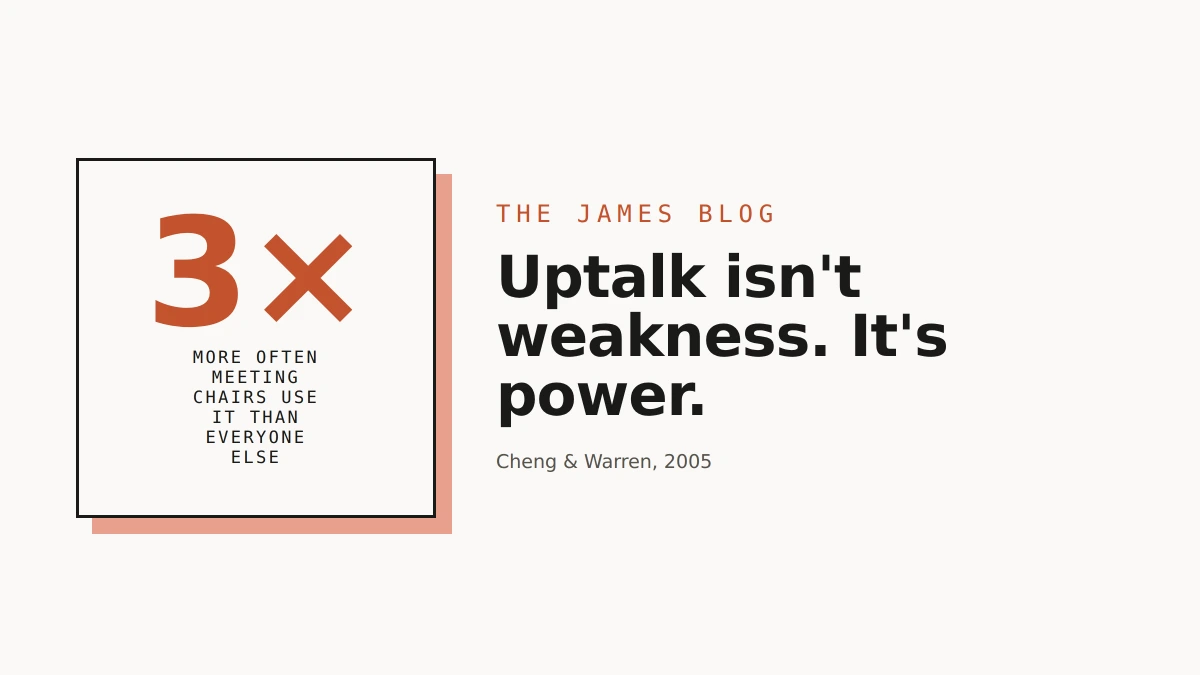
Uptalk means ending a statement with a rising pitch, so it sounds like a question. It is not automatically a sign you lack confidence. A study of real business meetings found the person chairing the meeting used that rising tone about three times more often than everyone else in the room. What actually costs you isn't uptalk in general. It's uptalk on the one sentence that's supposed to close something: a price, a deadline, a direct ask.
This is written for anyone who's been told to "stop uptalking." Maybe it was a coach, a manager, or a well-meaning friend, and you're not sure the advice is right. We read the primary research directly, instead of repeating what other blog posts say about it. That includes the studies behind both the "it signals weakness" claim and the ones that contradict it.
What is uptalk, exactly?
Uptalk is also called upspeak or high rising terminal. Wikipedia's summary of the linguistics puts it plainly: "declarative sentences can end with a rising pitch similar to that typically found in yes/no questions." Say "the proposal is ready" with a rising pitch on "ready." It starts to sound like "the proposal is ready?" even though you meant it as a plain statement.
It's not new, and it's not rare. It shows up across American, Australian, and New Zealand English, among plenty of other varieties, and it's been studied since at least the 1980s.
Does uptalk actually make you sound less confident?
That's the popular belief. Linguist Robin Lakoff argued rising tone was part of "women's language." In her view, it "reflected and reproduced its users' subordinate social status." The stereotype stuck: uptalk as hedging, as weak nerve, as a habit to train out of yourself before a big pitch.
The actual usage data tells a more complicated story. Mark Liberman, a linguist at the University of Pennsylvania, points to a 2005 study by researchers Winnie Cheng and Martin Warren, who recorded real business meetings. The chairs used rise tones almost three times more often than the other people in the room. Academic supervisors showed the same pattern, using rise tones almost seven times more than the students they supervised.
Earlier work points the same way. Cynthia McLemore's 1991 dissertation studied intonation inside a sorority. Wikipedia's overview of this research states that leaders of a peer group are more likely to use these rises in their statements than junior members are, citing McLemore's dissertation alongside Cheng and Warren's study. A 1986 study of Sydney speech, by Guy and colleagues, found something similar. The rise often held off interruption, by signaling the speaker wasn't done yet.
Put together, this points to a "checking in" function. A rise invites the listener to confirm they're following, or holds the floor while you keep talking. That's a long way from pure insecurity.
So who actually gets penalized for it?
Here's where it gets less comfortable. Researchers Aharon Mohliver, Anantha Divakaruni, and Laura Fritsch studied US CEO earnings calls. They applied voice analysis to recordings surrounding CEO transitions from 2011 to 2019. Incoming female CEOs who used high levels of uptalk got worse evaluations from analysts and investors after their first earnings call. Incoming male CEOs using the same speech pattern saw no penalty at all.
Same speech pattern, different consequence depending on who's speaking. That's a strong argument against treating uptalk as an objective flaw you either have or don't. Some of what reads as "weak" is the listener's bias, not the sentence.
None of this means rising tone never costs you. It means the cost isn't evenly spread across everything you say.
Where it actually costs you: the load-bearing sentence
Most advice treats every sentence the same and tells you to flatten all of it. That's the wrong unit. What matters is what the sentence is doing.
| Sentence type | What it's doing | Rising tone here |
|---|---|---|
| Check-in ("Does that make sense so far?") | Confirms the listener is following; holds your turn | Matches the function; not a problem |
| Transition ("So that covers the timeline...") | Signals you're not done yet | Matches the function; not a problem |
| Price ("The total comes to $12,000.") | Closes a decision; needs to land as settled | Reads as an opening to renegotiate |
| Deadline or commitment ("I'll have this to you by Friday.") | States something you're accountable for | Reads as tentative, invites a "really?" |
| Direct ask ("I'd like to move forward.") | Asks for a decision | Reads as a suggestion, not a request |
As of July 2026. Sources: see below.
Uptalk on a check-in line is doing exactly what the research says it does. Uptalk on the sentence that's supposed to close the deal is the one worth catching.
How to check your own calls for it, in 5 minutes
- Pull up a recording of a real call, not a script or a rehearsed pitch.
- Find your load-bearing sentences: where you stated a price, a deadline, a commitment, or a direct ask.
- Play back just those moments. Skip the rest of the call for this exercise.
- Listen to the pitch on the last word of each one. Does it rise like a question, stay flat, or fall?
- Count how many of those specific sentences rise. One is probably nothing. If it's most of them, that's your signal, not a general "you uptalk" verdict.
Don't run this same check on your check-in and transition lines. Those are supposed to invite a response. Flattening them doesn't help you; it just removes a signal your listener was using to know when to jump in.
What to do about it
- Rewrite the sentence, not your whole vocabulary. Take the specific price, deadline, or ask you found above and say it again, ending on your lowest, flattest tone instead of your highest.
- Cut the hedges stacked in front of it. "I think maybe the price would be around $12,000?" gives your voice three places to drift up before it even gets to the number. Say the number.
- Practice out loud with your phone's voice memo, not silently in your head. You can hear pitch. You can't feel it.
- Record the next real version of that sentence on an actual call and compare it to your practice take.
- Leave your check-in lines alone. They're not the problem.
If you're already listening back to your own calls, check this in the same pass as talk time and questions asked. It also pairs well with knowing your baseline speaking pace. Both come from the same few minutes on a real call, not a script.
Sources
- Wikipedia, "High rising terminal" — en.wikipedia.org/wiki/High_rising_terminal
- Mark Liberman, "Uptalk is not HRT," Language Log, University of Pennsylvania — languagelog.ldc.upenn.edu/~myl/languagelog/archives/002967.html (citing Cheng, W. & Warren, M., 2005, corpus study of English in Hong Kong business meetings; and McLemore, C. A., 1991, dissertation on intonation in a sorority)
- Anantha Divakaruni, research page hosting the abstract for Mohliver, A., Divakaruni, A., & Fritsch, L., "Equity Analysts Downgrade Stock Recommendations When Female CEOs Use Uptalk" — adivakaruni.github.io
Published July 20, 2026. Last verified July 20, 2026. This article is part of our research library. We publish what we learn building James, whether or not it sells an app.
Frequently asked questions
What is uptalk?
Uptalk (also called upspeak or high rising terminal) is when a declarative sentence ends with a rising pitch, the way a yes-or-no question does, instead of falling or staying flat. 'The proposal is ready' said with uptalk sounds close to 'The proposal is ready?'
Is uptalk always a sign you lack confidence?
No. That's the common stereotype, but it's not what the research on actual usage shows. Studies of real business meetings and workplace hierarchies found people in senior or leading roles use rising tone more often than junior people do, not less. It also serves a real function: checking that the listener is following along, and signaling you're not finished talking yet.
Does uptalk hurt you on a sales call?
It can, but not evenly across the whole call. The sentences where it's more likely to cost you are the ones meant to land as settled: a price, a deadline, a direct ask. Ending those on a rising note can read as an invitation to negotiate, even if that's not what you meant. Uptalk on a check-in line like 'does that make sense so far?' is doing what it's supposed to do.
Do men and women get judged the same way for using uptalk?
Not according to at least one study. Research on CEO earnings calls found analysts downgraded their evaluation of incoming female CEOs who used high levels of uptalk, while incoming male CEOs using the same speech pattern saw no change in evaluation. The pattern says as much about listener bias as it does about the speaker.
How do I stop uptalking on the sentences that matter?
Find your load-bearing sentences first (price, deadline, commitment, ask), not your whole vocabulary. Play those specific moments back from a real call, listen for the pitch on the last word, and if it's rising, rewrite the sentence to end on your lowest, flattest word instead of your highest one. See the 5-minute method below.