Why do we say “um”?
You say “um” when you reach the end of a thought before the next one is ready. Speech and thinking run on slightly different clocks. When your mouth gets there first, it grabs the nearest sound to hold the floor — um, uh, like, so — so nobody jumps in while you catch up.
That’s the whole mechanism. It’s not nerves, and it’s not a small vocabulary. Even fluent, expert speakers do it. Which is good news: if the cause is timing, the fix is timing too — not memorizing fancier words.
Filler words aren’t the disease. They’re the sound your mouth makes while it waits for your brain. The James Team
Is saying “um” actually bad?
A little is fine. Everyone does it, and listeners tune out the occasional filler completely. It only starts to cost you when it clusters — several “ums” a minute — because that’s the point where people stop hearing your message and start hearing your hesitation. In a room where you want to sound decided, that gap reads as doubt.
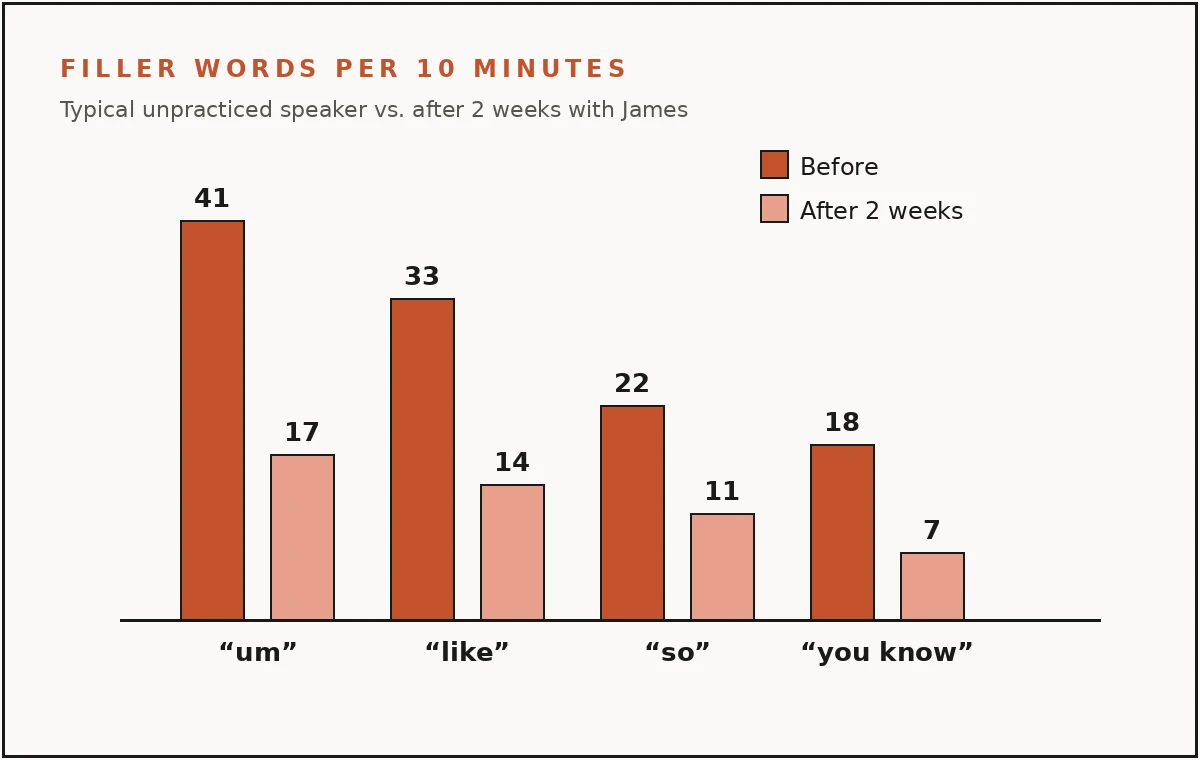
So the target isn’t zero. Chasing zero makes you stiff. The target is low enough that no one notices. Here’s what that shift looks like when you measure it:
The 5-step method to stop saying “um”
1. Measure your baseline
You can’t fix what you don’t count. Record two minutes of yourself explaining a normal work topic, then play it back and tally every filler. Most people are shocked — the habit is invisible from the inside. A quick audit looks like this:
0:12  "So— um— I think we should, like, ship it?"
0:19  "Yeah, you know, it's, uh, mostly done."

       um ×2 · like ×1 · you know ×1 · uh ×1
       → 5 fillers in 9 seconds
2. Replace the filler with a pause
This is the core move. When you feel an “um” coming, say nothing instead. Close your mouth and let the silence sit. It feels endless to you — a half-second pause feels like five — but to the room it reads as control. The pause also does the job the “um” was doing: it buys your brain the beat it needs.
Try this: when you notice the urge to fill, press your lips together for one full beat. You’re training a new default: gap → silence, not gap → sound.
3. Slow down your first ten seconds
Most filler happens at the start — the first sentence out of your mouth, before you’ve found your footing. Open slower than feels natural. A deliberate first line sets the pace for everything after it, and it’s the part people judge fastest.
4. Speak in shorter chunks
Long, winding sentences run out of runway, and that’s where fillers bridge the gaps. Say one idea, stop, say the next. Short chunks give you natural landing points to breathe — so you never reach that end-of-thought cliff mid-sentence.
5. Review the tape
The habit is invisible live, so you have to see it after. Once a day, listen back to a real conversation and count. What gets measured gets managed — and the counting itself rewires you, because now part of your attention is listening for the pattern in real time.
Here’s the same five steps as a quick reference, with what each one replaces:
| Step | Old habit | New habit |
|---|---|---|
| Measure | Guessing you’re “fine” | Counting fillers on tape |
| Pause | “Um” to hold the floor | A short silent beat |
| Slow the open | Rushing the first line | A deliberate first sentence |
| Chunk | One long, winding sentence | Short ideas with landings |
| Review | Never hearing yourself | A daily 2-minute playback |
How long until it sticks?
Give it two to three weeks. You’ll hear a clear drop in the first few days just from noticing, and the pause becomes your default inside a fortnight. The trick is daily reps on real conversations, not one big practice session — which is exactly the part most people skip, because reviewing yourself every day is tedious to do alone.
That’s the problem James was built for: it sits in on your real calls, counts your fillers for you, and shows you the two moments to fix — no stopwatch, no self-tallying.
Frequently asked questions
Is it bad to say “um” when you speak?
A few filler words are normal and human — they don’t hurt you. It only becomes a problem when “um” shows up several times a minute, because that’s when listeners start hearing hesitation instead of your point. The goal isn’t zero; it’s low enough that nobody notices.
Why do I say “um” so much?
You say “um” when your mouth reaches the end of a thought before your brain has the next one ready. The filler fills the gap so you don’t lose the floor. It’s a timing habit, not a lack of intelligence or preparation — which is why the fix is about timing, not vocabulary.
How long does it take to stop saying “um”?
Most people cut their filler rate by half in about two to three weeks of light daily practice. You won’t eliminate it overnight, but you’ll notice a clear drop within the first week once you start replacing fillers with a short silent pause.
What should I say instead of “um”?
Say nothing. Replace the filler with a short silent pause. Silence feels long to you but reads as confidence to everyone else, and it gives your brain the half-second it needs to line up the next thought.