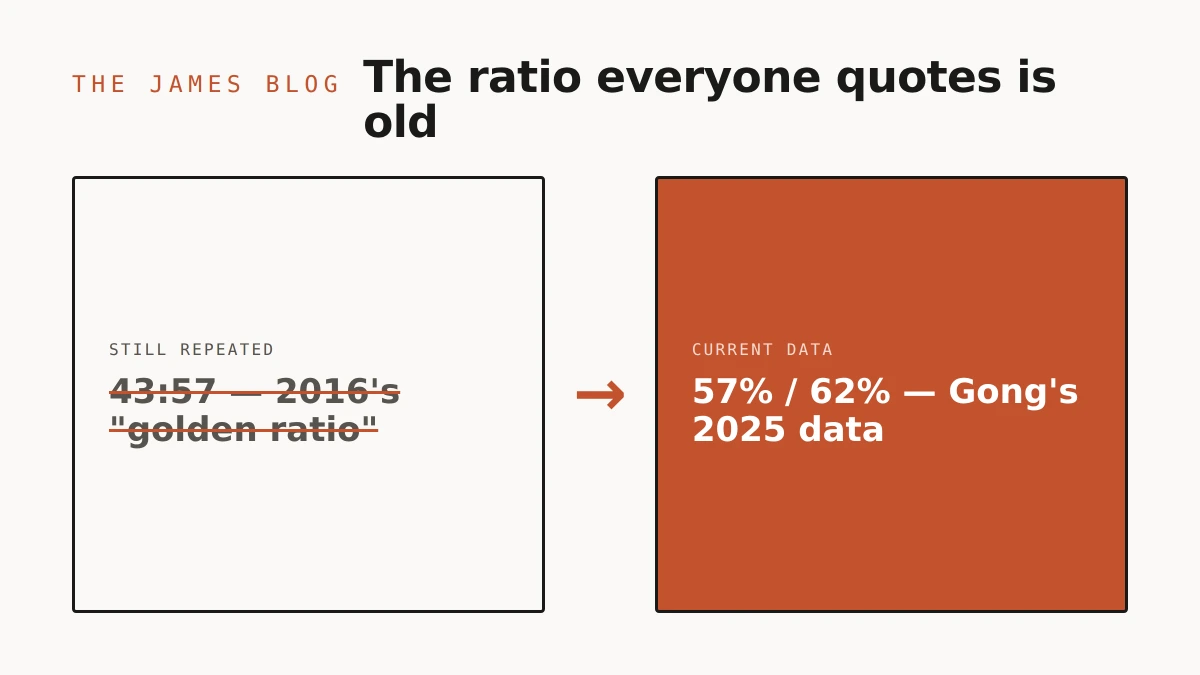
On closed-won sales calls, reps talked 57% of the time. On lost calls, 62%. That's Gong's current data: 326,000 calls, minimum 10 minutes each, last updated by the company in March 2025. It's not the number you'll find on most of the blog posts ranking for this exact phrase. Most of them still quote a "43:57 golden ratio," 43% talk and 57% listen, and attribute it to the same company. That's the older version of the same research, from before the 2025 refresh.
This is written for anyone who has read three different "ideal talk-to-listen ratio" numbers on three different sites. You want to know which one is current. We read Gong's live source directly instead of a secondhand summary, checked what Gong's own product tracks alongside the ratio, and tested whether the popular "sales coaches should talk even less" claim has real research behind it. We also read our own banked App Store reviews of Siro and Rilla, two apps built around reviewing real sales calls, to see how people who do this every day actually talk about talk time.
Why do sites disagree on the ratio?
Because they're citing two different versions of the same research, several years apart. Most of them haven't caught up to the newer one.
The "43:57" figure comes from Gong's original 2016 analysis. It recommended a ratio of roughly 43% talk time to 57% listen time, framed as a target to aim for. It still gets repeated as "the golden ratio" on sales-content sites today. Gong's own page was rewritten in March 2025. The current version reports something different: not one target ratio, but a comparison of what actually happened on calls that closed versus calls that didn't.
| Older version (still widely repeated) | Current Gong data (updated March 2025) | |
|---|---|---|
| Framing | A single "ideal" ratio to aim for | A comparison of won vs. lost outcomes |
| Reported split | 43% talk / 57% listen | Won: 57% talk / 43% listen. Lost: 62% talk / 38% listen |
| Overall average | Not stated as such | 60% talk / 40% listen, across all 326,000 calls |
As of July 2026. Sources: see below.
If you've seen "43:57" cited as Gong's current position, that's the piece to update. If you've seen "57% talk time" cited as the ideal with no qualification, that's incomplete too. 57% is what won deals averaged, not a ceiling to chase. The same data shows 62% on lost deals. A lot of overlap sits in between.
Is a fixed ratio even the right thing to chase?
The data itself argues against it. Buried in the same Gong figures is a detail most summaries skip. Low performers' talk time swings by 10 points depending on how the call goes: 54% on won deals, 64% on lost ones. High performers don't swing. Their ratio holds roughly steady whether the deal closes or not.
That reframes the whole question. A single-call ratio isn't a score to hit once. It's more useful read as a consistency check across many calls. Picture two reps. One talks 60% on a great call and 60% on a bad one. The other sits at 50% on wins, then spikes to 65% under pressure. By this data, the first rep looks more like a top performer, even at a higher raw number.
What does the ratio miss entirely?
Monologue length. Two calls can land on the exact same 57% talk-to-listen split and be completely different conversations. One is built from a dozen short exchanges. The other is one five-minute uninterrupted pitch followed by a lot of quiet listening. The ratio treats them identically. It shouldn't.
Gong's own research gestures at this directly: "Lost deals often feature long seller monologues," while calls that closed featured shorter ones. The company doesn't put an exact second count on that claim in this piece. But its own product does, in a separate, less-cited feature. Gong tracks something called Longest Monologue. It's the longest unbroken stretch a rep talks in a single call, averaged across their calls. The guidance is direct: reps should "speak for no more than 2.30 minutes at a time." A longer uninterrupted stretch doesn't give "the customer time to respond and express their pain points." None of the current top-ranking pages for "talk to listen ratio" mention this metric at all. That's a real gap, if you actually want to fix your calls instead of just tracking a percentage.
This isn't just a vendor's idea of a good metric. It's the number a working rep reaches for. One Siro user, reviewing the app unprompted, listed the insights they actually watch:
"...view insights such as my words per minute , # of exchanges , longest monologue..." Siro, 5★, "Siro is a GAME CHANGER," March 2023
They said it keeps them "on point." Not "talk-to-listen ratio." Longest monologue. That's the number they named when asked what keeps them sharp.
What do people who watch their own calls actually call this?
Almost anything but "talk-to-listen ratio." We searched our banked App Store reviews of Siro and Rilla, 129 reviews between the two apps and both built on reviewing real sales calls, for how reviewers describe talk time. The phrase itself, with its colon and its jargon, shows up essentially never. What people say instead is plainer:
"Are they talking too much or too fast? Are they skipping parts of the presentation?" Rilla, 5★, "The best sales tool I've seen," October 2023
Two of those 129 reviews name this behavior directly, so treat it as a signal, not a survey, and remember the reviews skew toward people happy enough to leave five stars. But it lines up with the point. Real practitioners track "am I talking too much" and "how long did I run on," not a ratio with a colon in it. If you're going to measure yourself, measure the thing you'd actually say out loud.
Should a coach talk even less than a rep does?
It's a reasonable-sounding idea, and it shows up often. Sales coaching and consulting circles cite something like a "70/30 rule": the coach talks roughly 30% of a session, the client the rest. We went looking for the study behind it. There isn't one. The sources that state it plainly call it "commonly used," or informal convention. No research or named study is attached.
That doesn't make the idea wrong. Coaching someone is a different job than closing a deal yourself, with a different rhythm. 30% is a sane default. It just isn't evidence. It isn't the same research as Gong's sales-call figures above, either. Don't stack a rep's data-backed 57–62% next to a coach's un-sourced 30% and treat them as two points on one scale. They're measuring two different kinds of conversation.
How do you check your own ratio without call-recording software?
- Pick one real call, ideally not a scripted or rehearsed one.
- Time your total talking, either with a stopwatch running only while you speak, or by getting a rough transcript and counting words (roughly 150 words per minute of talking, as a conversational baseline).
- Divide your talk time by the call's total length. That's your ratio for that one call. One call isn't a trend; do this for 3–4 calls across a week before drawing a conclusion.
- Separately, time your single longest unbroken stretch of talking on the same calls. If any one of them clears 2:30, that's the more actionable finding, independent of what your overall ratio says.
- Watch for the swing, not just the number. If your ratio holds close to the same value regardless of how the call went, that's the pattern Gong's data ties to stronger performers. A big jump on the calls that went badly is the more useful thing to notice.
What to do with this
- Stop citing 43:57 as current if you've been using it; the company's own site has moved past it.
- Track your longest monologue, not just your overall ratio, for at least one call this week. It's the more diagnostic number and almost nobody else is measuring it.
- Check for a swing, not a target. A ratio that holds steady across a good call and a bad one says more than any single number does.
- If you're coaching, not selling, don't borrow the sales figures wholesale. Use the informal 70/30 convention as a default if you like it, but don't call it data. A weekly self-review habit works well for either job — this is one more signal to fold into it, not a replacement for it.
Sources
- Gong, "Mastering the Talk-to-Listen Ratio in Sales Calls," originally published 2016, updated March 20, 2025 — gong.io/blog/talk-to-listen-conversion-ratio
- Gong Help Center, "Analyze Team Performance" (Longest Monologue metric) — help.gong.io/docs/analyze-team-performance
- Our method: we read the current version of Gong's own source page directly, rather than relying on the many secondhand summaries of it, and separately checked Gong's own product documentation for the monologue metric and a coaching-industry source for the "70/30" claim, to confirm which numbers are actually current and which have real research behind them. We also searched our banked App Store reviews of Siro and Rilla, 129 reviews between the two apps, pulled earlier in 2026, for how real users describe talk time; the quotes are verbatim, with the app, star rating, review title, and month shown.
Published July 24, 2026. Last verified July 24, 2026. This article is part of our research library. We publish what we learn building James, whether or not it sells an app.
Frequently asked questions
What is a good talk-to-listen ratio for a sales call?
Gong's current data, from 326,000 calls updated March 2025, shows reps talked 57% of the time on calls that closed and 62% on calls that were lost. That's descriptive, not a target to hit exactly. The more useful pattern in the same data: low performers' ratio swings by 10 points between won and lost calls, while high performers stay steady regardless of outcome. Consistency matters more than landing on one precise number.
Is the 43:57 talk-to-listen ratio still accurate?
It's the older version of the same research. A 43% talk / 57% listen split, credited to Gong, still circulates on sales blogs as 'the golden ratio.' Gong's own site was substantially updated in March 2025, and the current figures on that same page are different: 57% talk time on won deals, 62% on lost. If you're citing 43:57 as Gong's current position, you're citing the pre-refresh number.
What is Gong's 'Longest Monologue' metric?
It's a separate metric Gong's own platform tracks: the longest uninterrupted stretch a rep talks in a single call, averaged across their calls. Gong's guidance caps it at 2 minutes 30 seconds. Two calls can carry the identical 57% talk-to-listen ratio; one built from short back-and-forth turns, the other from one long unbroken pitch. The ratio can't tell those apart. Monologue length can.
Should a sales coach talk less than a salesperson does?
Maybe, but there's no real data behind the specific number usually attached to that idea. A '70/30 rule' circulates in coaching circles (the coach talks roughly 30% of the session, the client 70%), presented as informal convention with no study behind it. Treat it as a reasonable default for a coaching conversation, not as evidence, and don't confuse it with Gong's sales-call research, which measures a different kind of conversation entirely.
How do I measure my own talk-to-listen ratio without buying call-recording software?
Play back a real call, start a stopwatch when you start talking and stop it when the other person does, and add up your total speaking time versus the call's total length. Do the same for your single longest unbroken stretch of talking. Both numbers take under 10 minutes to produce for one call, no transcription or software required. See the method below.