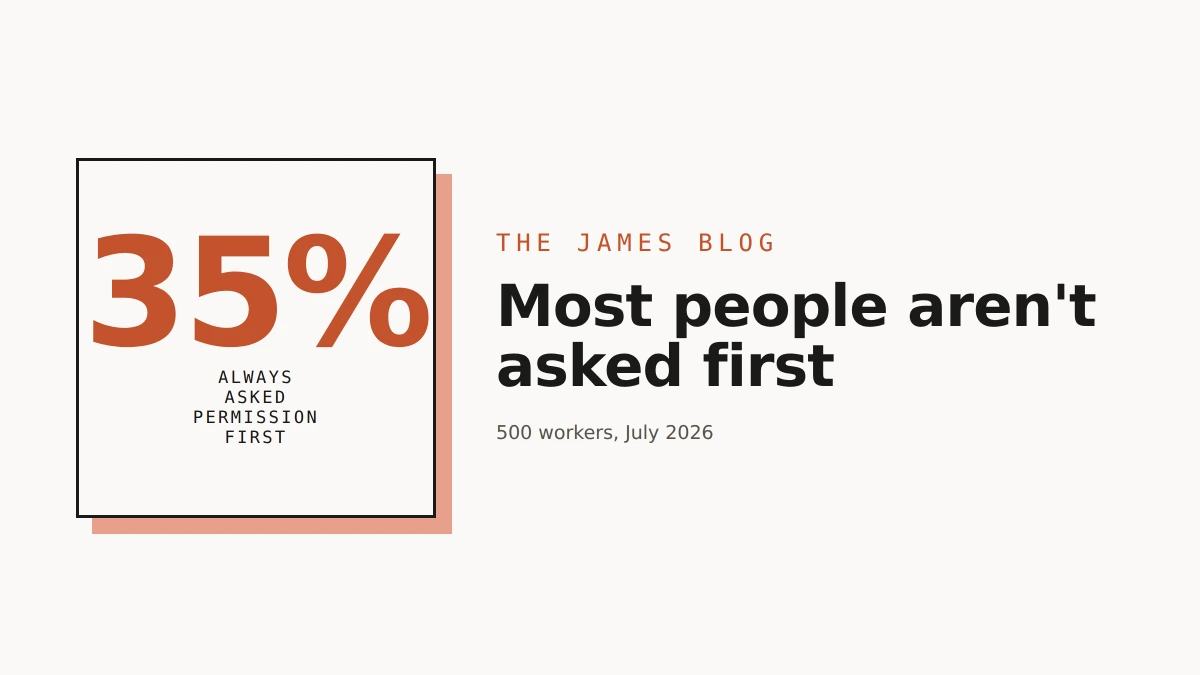
Yes, as long as you say so first. The etiquette problem with AI notetakers isn't the recording. It's the ones nobody mentions out loud. A July 2026 survey of workers whose meetings include an AI notetaker found only 34.7% say they're always asked for permission before it starts. A quarter say they're never asked at all.
We read 200 recent App Store reviews of the two biggest notetaker apps for an earlier study. Permission came up exactly twice. Among the reviews that specifically mention a client, it came up zero times. People are recording client conversations every day and almost nobody is writing about whether they asked. Here's what the data says, and the two sentences that fix it.
How often do people actually get asked before a notetaker records them?
Less than half the time. A July 2026 survey asked this directly. It polled 500 employed US adults through Pollfish, commissioned by Kolmogorov Law. Of those, 167 said a notetaker or transcription bot had sat in on their meetings. Here's how that group answered:
| What happened before the bot recorded | Share of workers exposed to a notetaker |
|---|---|
| Always asked permission first | 34.7% |
| Asked only sometimes | 36.5% |
| Never asked, bot just appeared | 25.1% |
| Learned about the recording afterward | 3.6% |
Survey of 500 employed US adults, subsample of 167 exposed to an AI notetaker. Margin of error ±7.6% on that subsample. Fielded July 2026. Commissioned by a law firm (Kolmogorov Law), distributed via Stacker. A marketing-commissioned survey, not peer-reviewed research; we cite it with that caveat.
Only the top row counts as consistent disclosure. Everyone else, 65% of people who sat through a notetaker meeting, wasn't told every time, or wasn't told at all. The same survey found one more gap. Only 35% of workers knew some states legally require every participant's consent before a call can be recorded at all.
What do people actually say in AI notetaker reviews about clients and consent?
Almost nothing. That's the finding. For an earlier study, we read the 100 most-recent US reviews of Otter and 100 of Plaud, the two biggest standalone notetakers. That's 200 reviews total. This week, we reran that count for two things: mentions of clients, and mentions of permission or consent.
Permission or consent came up in 2 of the 200 reviews. Both are from the person doing the recording, not the person being recorded:
"I primarily use Otter during interviews, always with the candidate's permission." five-star Otter review
"I've had to get some legal backup to convince places like my HOA board to allow me to record and transcribe…" five-star Otter review
Four of the 200 reviews name a client by name. A contractor logs job conversations. A writing coach works with clients on a book. Two more mention a client in passing. None of the four say a word about asking first.
Four reviews is a small sample. We won't pretend it proves a pattern on its own. But it matches the survey above, and it matches the larger 663-review study this piece follows up on. Consent is close to invisible in how people talk about these tools. That holds whether or not a client is on the call.
What should you actually say before you record a client call?
One sentence, said out loud, before anything joins the call or starts recording. Not buried in a calendar invite nobody reads.
If it's your notetaker or your recorder:
"I'd like to record this so I'm not scribbling notes while we talk. That okay with you?"
Say it before the bot joins, not after. If the answer is anything but a clear yes, take notes by hand instead. A calendar-invite disclosure is a fine backup, not a substitute for saying it in the room.
If someone else's bot shows up on your call:
"I see [tool] joined. Mind if I ask what happens to the recording, and who sees it?"
You're allowed to ask. You're allowed to say no. If you'd rather it not record you, say so directly: "I'd rather we not record this one, is that all right?" Most tools remove the bot the moment the host says so, and the ones that don't are telling you something about how the meeting is run.
Both scripts do the same job: they turn a silent recording into a conversation both people had. That's the entire etiquette problem, solved in one sentence, every time.
Does any of this actually matter legally?
In roughly a dozen US states, yes. This isn't just etiquette there. California, Florida, Illinois, and several others require every person on a call to agree before it's recorded. A handful more have gray zones between the written statute and the actual court rulings.
We built the full state table in a companion guide. It comes with exact scripts for four scenarios: coaching, sales, real estate, and in-person meetings. This is general information, not legal advice. Check your own state before you record anything you'd rather not explain later.
What to do before your next client call
- Decide out loud, before the call, not during it. Say the one-sentence script above. It takes less time than it took to read this paragraph.
- If someone else's bot joins uninvited, ask what happens to the recording. You don't need a reason to ask, and you're allowed to decline.
- Check your state if you're not sure. The full table is in the companion consent guide, and it's free to look up before you record anything real.
- Don't confuse "notetaker" with "coach." A transcript is a record of the call. It won't tell you what to fix before the next one. That's a different job, and it's the one we build for.
Sources
- Kolmogorov Law / Pollfish, "AI notetakers have sat in on 1 in 3 US workers' meetings, but only a third say they were asked first," survey fielded 2026-07-08, published via Stacker 2026-07-17 — abc17news.com/stacker-business-economy/2026/07/17/ai-notetakers-have-sat-in-on-1-in-3-us-workers-meetings-but-only-a-third-say-they-were-asked-first/
- Our companion study, "What 663 App Store reviews say about AI notetakers," james-app.com/blog/ai-notetaker-reviews-study/
This is general information, not legal advice. Laws on recording consent vary by state and change over time. Check your state's current statute, or ask a lawyer, before you record anything you'd rather not explain later. As of July 2026.
Published July 21, 2026. Last verified July 21, 2026. This article is part of our research library — we publish what we learn building James.
Frequently asked questions
Is it rude to use an AI notetaker on a client call?
Not if you say so before you hit record. It becomes a problem when the bot shows up in the participant list unannounced, or when the client only finds out afterward. Naming it takes one sentence and removes almost all the friction.
Can I say no to someone else's AI notetaker?
Yes. It's your call too. Ask what happens to the recording and who sees it, and you're allowed to ask for it to stop. Most tools remove the bot the moment the host says so.
Do I have to tell a client I'm recording the call?
In roughly a dozen US states, yes, by law, and every state at least considers it good practice. We've written the full state-by-state table with exact scripts for four scenarios in a companion guide (general information, not legal advice).
What's the actual complaint rate about AI notetakers in client meetings?
Billing dominates the complaints, not consent. In the 663 App Store reviews we read for a companion study, 38% of low-star reviews were about charges and trials. Consent barely came up in the reviews at all: twice in 200 notetaker reviews, and never once in the reviews that specifically mention a client.